Feature Profiles
13 January, 2026
SUMMER READING In parcels of comfort
Ken Arnold writes about efforts on the home front in World War One
ON THE railway line between Mitiamo and Pyramid Hill near the Bullock Creek, a crumbling school building marks the town of Mologa.
The town, 13km out of Pyramid Hill was once home to almost 400 people in 1911. It had its own tennis association, football association, railway station, two schools and multiple churches. However it is now home to only 20 people and remnants of old buildings.
Sixty years ago, the old creamery and butter factory still stood, along with a hall, an old store, a church and a school. Instead of buildings these locations are marked with plaques to remember what was lost to time.
Despite being a small town, the Mologa branch of the Red Cross Society was actively involved in providing relief during World War One and Two.
They despatched 40 flannel shirts, 10 triangular bandages, eight pillow slips, three scarves, six knitted face washers, 10 towels, four bars of soap, a bag, seven bandages, a cushion, a large tin of biscuits, five tins of cocoa, a tin of Benger’s food and a parcel of books and magazines to the central depot in April 1916.
This was followed by a similar parcel in June.
On July 17, 1916, The Rev. Hedley Plumtree delivered a lecture on the European War, illustrated by lantern slides, in aid of the Red Cross Fund, in the Mologa Hall. Admission to the lecture was by silver coin which had good attendance.
The barn was the scene of a euchre party followed by supper and dancing in
aid of the Prisoners of War Fund in October 1917.
As the weather was inclement and the roads in poor state the attendance was small however the following day the station was a colourful scene it being decorated with flags, bunting and greenery to welcome Private Charlie Fyfee back from the war he having been wounded in a bombing raid the previous November.
In March 1918 the townspeople despatched another box to the central depot of the local Red Cross branch which contained the following: 7 lbs. tea. four bags
oatmeal. 12 packets jelly crystals, six packets cornflour, six packets arrowroot, six tins cocoa, six tins coffee, four sheets, 36 handkerchiefs, two pairs socks. four scarves, 12 kitchen towels and six toilet towels.
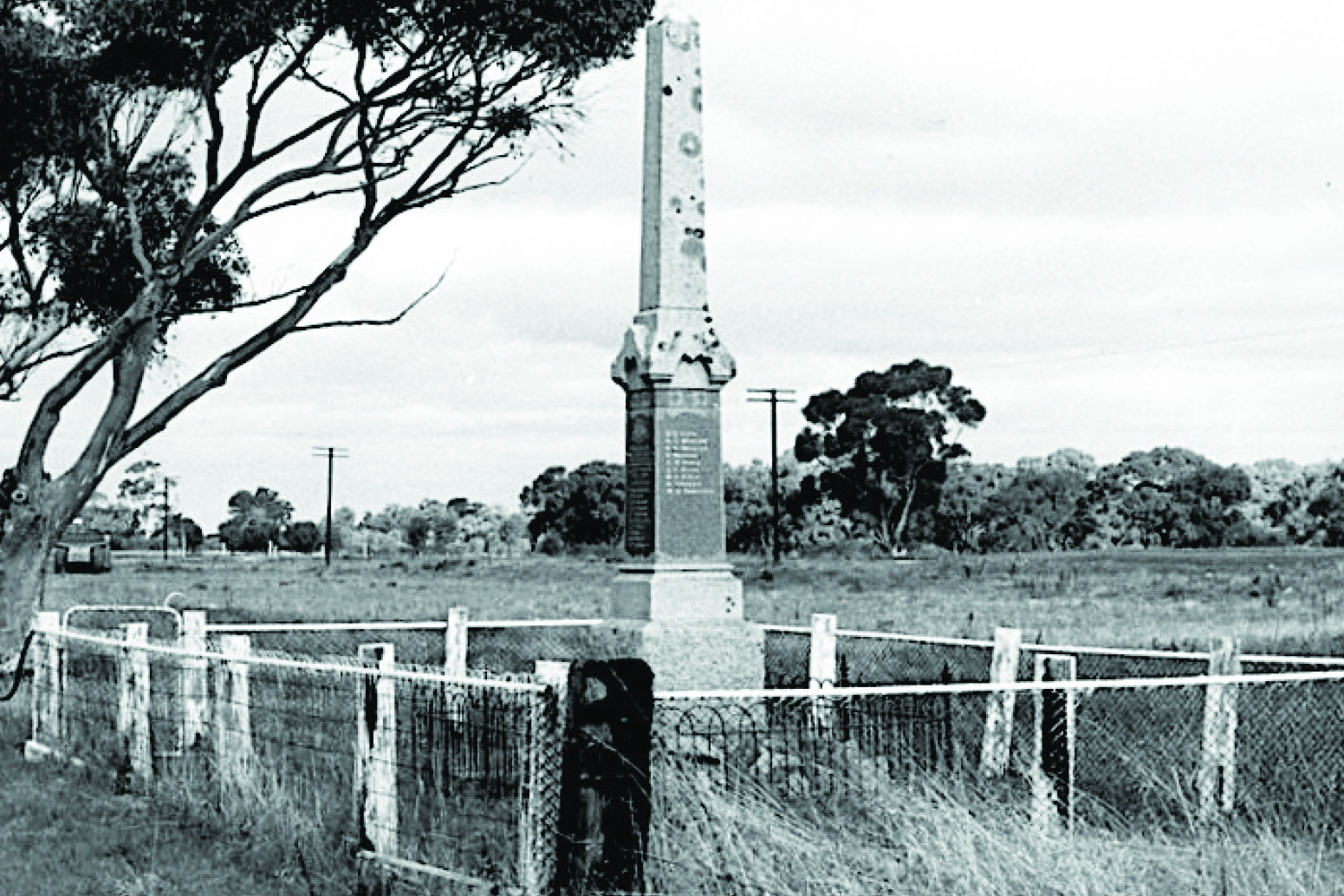
The Pyramid Hill Advertiser reported on December 6, 1918, that the residents of Mologa gathered for a picnic in the corner of a nicely shaded and grassy paddock on the Pickles farm to discuss raising funds for a suitable memorial to the local soldiers to recognise their valour and to keep in memory of those who gave of their life.
As a result, an impressive memorial was unveiled by Mrs. Marlow on March 24, 1921.
Mrs Marlow had five sons volunteer for the war effort, they were a part of the twenty young men from Mologa who were farewelled from the railway station.
Only half the men returned, included in the ten men who did not return were three of Mrs Marlow’s sons.
The Mologa branch of the Red Cross was still active in November 1940.
In recent years Mologa was often identified by the haybale art along the highway. Around 2019 the first three of ten hay bale soldiers in memory of the ten men who did not return were put in place at the corner of the Bendigo-Pyramid Road and Mologa road.
The soldiers were well painted, each having a turned-up sheet of iron for the brim of the hat. Unfortunately, this artwork was unable to withstand long term exposure and has been taken down.
The honour rolls for the Mologa schools and St Luke’s Church of England can be seen at the Pyramid Hill RSL Hall, McKay Street, Pyramid Hill
Mologa can be visited by travelling to Mitiamo passing through that small township on past the local golf club and through Terrick Terrick forest.
Then you come to the Mologa - Echuca road, turn left and travel down past the old school which has collapsed, or failing that take the Bendigo - Pyramid Hill road turning right into the gravel Mologa Echuca road.
It’s worth to drive to discover more of our local history.