General News
12 January, 2023
Dullness of a gamble
SUMMER READINGBy KEN ARNOLDTHE Deakin-Gillies Government began buying land on both sides of the Loddon river in readiness to build a weir upstream from the small township of township of Janevale in the 19th century. Now known as Laanecoorie, the...
SUMMER READING
By KEN ARNOLD
THE Deakin-Gillies Government began buying land on both sides of the Loddon river in readiness to build a weir upstream from the small township of township of Janevale in the 19th century.
Now known as Laanecoorie, the location was described as being dull whilst gambling was characteristic of the state of affairs.
The cost of building the weir was expected to be about £85,000 plus £48,308 was to be spent to purchase the 1053 acres of land.
The Laanecoorie weir, the second water storage to be built in Victoria, was designed by Stuart Murray and Carlo Catani for the Loddon United Water Trust.
Andrew O’Keefe commenced work in January 1889, he having some involvement with Joshua Thomas Noble Anderson and Stuart Murray, there being 80 men and 20 women engaged.
The tender price was to be £57,321/15/6, also recorded as £46,000, however, on December 27, 1888, Deakin authorised an amount of £63,541/9/0 for the construction of a concrete weir, earthen dam and other works on the Loddon River.
The concrete masonry weir, with a line of wrought iron automatic gates similar to the design of Chaubart, but designed by civil engineer Ebb, they being the first of this sort erected in the colony.
The main wall was 320 feet long, it being anchored into the natural sedimentary rock on the left hand side whilst on the right hand side the wall was puddled clay, making the overall length of the wall 1020 feet, it being 52 feet wide at the base and 12 feet wide at the top, the height being around 34 feet plus the gates.
The weir was capable of holding 610 million cubic feet of water.
The residents of Laanecoorie were soon requesting extra police presence in the township owing to the number of men engaged on constructing the weir and those who were being employed by the contractor in clearing the land in readiness for the Maldon-Laanecoorie railway which was planned to be extended on past the Shelbourne station, according to reports in February 1889.
The railway line was to continue on from the Shelbourne station to the Bible Christian church at Cousin’s Corner, Woodstock West.
Although the earthworks for the line was completed from the station to Blossom Hill road, no further work was done.
There were numerous rallies, meetings, protests as to where railway lines should or should not be built.
At one stage the line was going to cross the Loddon River somewhere near Newbridge and go on to between Llanelly and Arnold whilst it was also suggested it should head north to the railway line between Derby and Bridgewater.
Although a powerful Hall’s patent steam stone breaking machine with multiple action was erected on the west bank in readiness to crush rock in May 1889 the continual flooding caused the work to be suspended for several months hence this machine did not commence work until December, as the mud had to be cleared from the bed rock before the laying of concrete could begin on January 4, 1890.
Work had just begun on the wall when there was a partial break in the embankment in the February.
Meanwhile on June 1, 1889 Andrew O’Keefe was fined for neglecting to provide proper closet accommodation for the 100 men and women employed at the weir or camped thereat along with the filthy state of camp it having no proper scavengering.
As a result at least 25 people contracted typhoid of which five cases were fatal.
Mr. Saunders, the manager for the contractor, was ordered to remove the closets further away from the works whilst separate closets had to be provided for the women, provide deodorisers and that the refuse be removed two or three times a week. All up fines and costs of £41/7/- were inflicted.
A tender of £249/17/6 by A. P. Chapman was accepted to build the caretaker’s cottage at the weir in August 1889.
Four 36-inch diameter outlet valves were manufactured by Abraham Roberts of the United Iron Works, Sandhurst (Bendigo.)
These valves were capable of discharging 44,000 cubic feet of water per minute, they to be controlled from the gangway (bridge).
Employee T. King was crossing the embankment with a horse and dray when they were precipitated into the drink. Both King and his horse drowned in August 1890.
One of the workmen fell into an excavation for the puddle wall, a depth of 40 feet, he surviving the following month.
At that time a byways channel was to be excavated to the west of the wall.
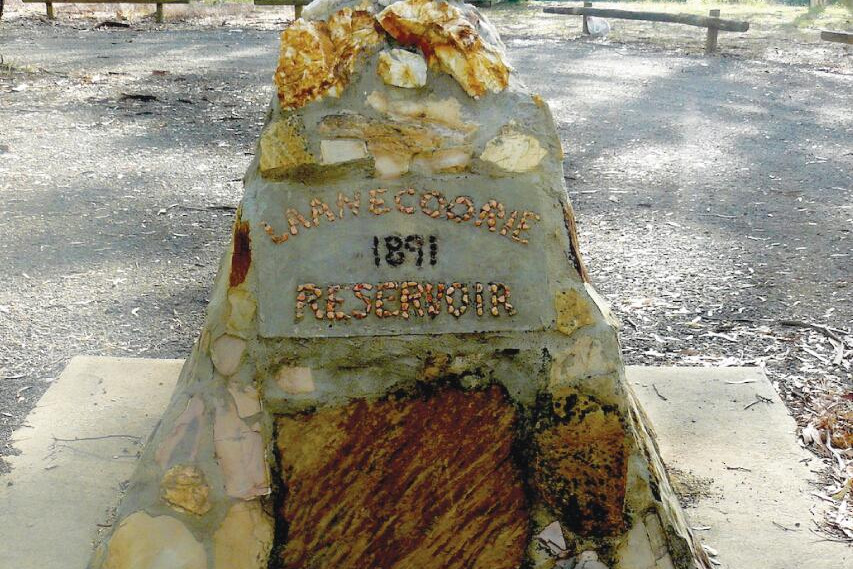
The weir was completed by March 1891, the final cost being around £133,876, there having been numerous inquests into the price paid for the land.